2.85-litre flat-six · sequential twin-turboLongitudinal rear-engine, variable all-wheel driveTopology diagram · not to scale · based on the cited primary sources
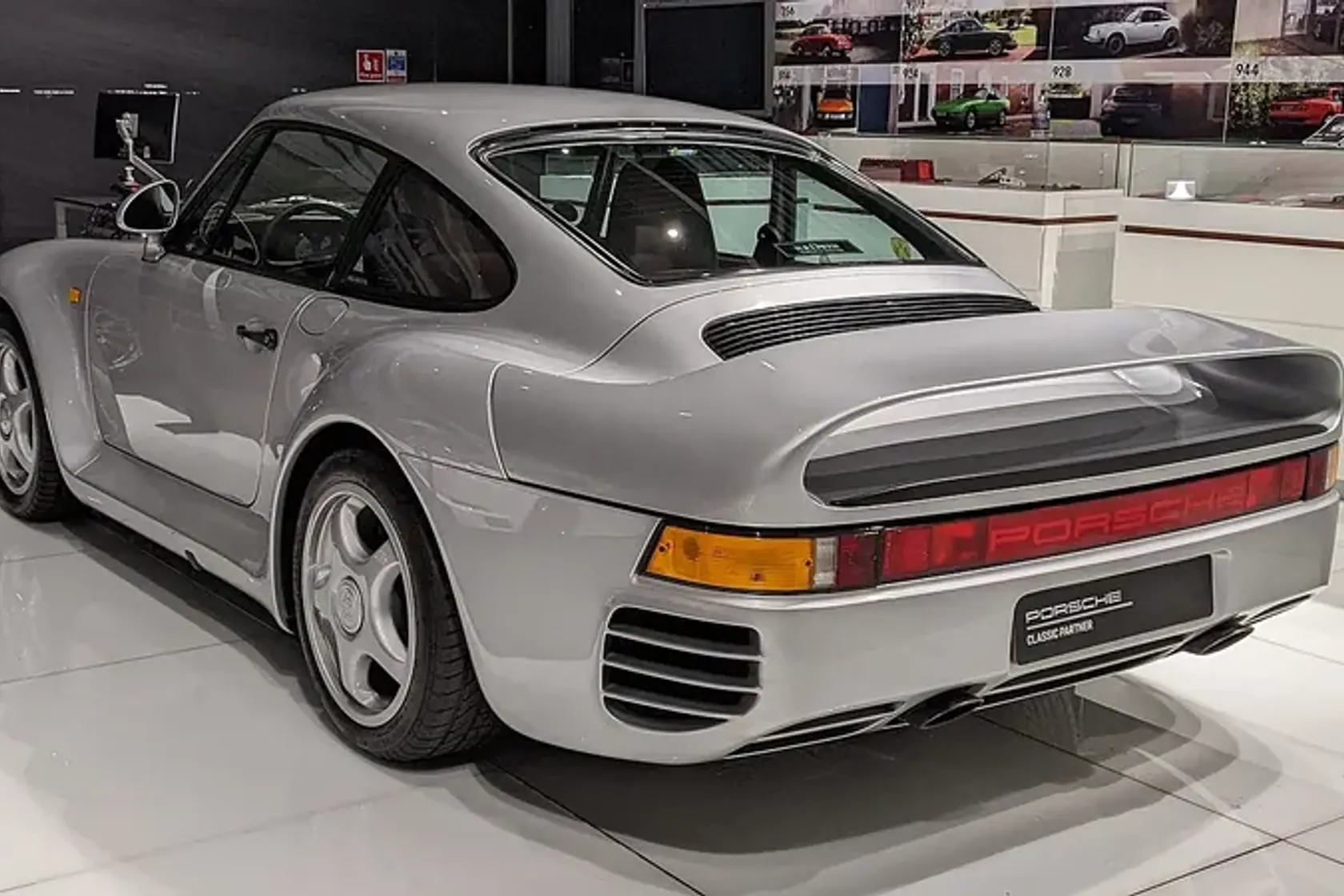
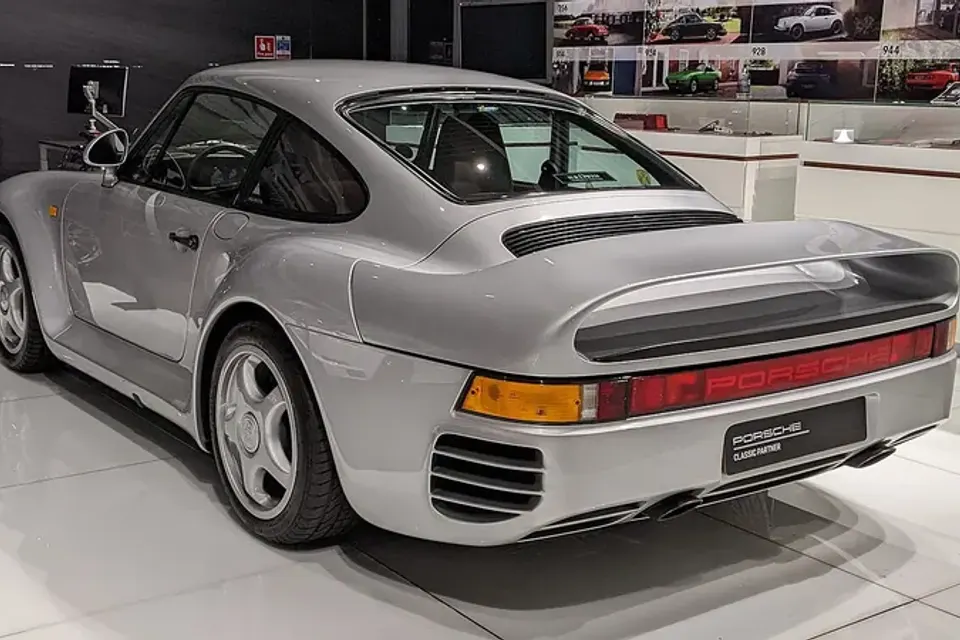
959 is the exact Type 959 production representative for the Porsche 959 milestone in this archive’s source-led family tree.
R / production rarity
How rare is it?
A simple 1–5 rating based on completed worldwide production for this exact version. Price and desirability are not included.
The rating uses five fixed production bands. Smaller production runs receive higher ratings. Exact totals and responsibly sourced estimates for this precise version can be rated. Plans, regional totals, lower bounds, disputed figures and broader-family totals remain visible but unclassified. The evidence description is kept separate from the rating so a source limitation cannot change how scarcity is measured.
5/5Fewer than 25 builtUltra rare
4/525 to 249 builtVery rare
3/5250 to 2,499 builtRare
2/52,500 to 24,999 builtLimited production
1/525,000 or more builtSeries production
Recorded sales
Documented sales
Prices never affect the rarity rating.
Sold€1,008,0002016 · RM Sotheby's · Duemila Ruote
Auction result
Exact 959 Komfort · 1988 configuration
Published official auction result; Komfort specification must not be compared directly with the 29-car 959 Sport subset.
Open-licence recordings can appear with a visible Unregistered note; archive verification still requires independent identity and configuration evidence.
Listening descriptors remain editorial; architecture and output claims trace to the cited manufacturer material.
The Porsche 959 emerged from a programme begun in the early 1980s around Group B regulations. Porsche first showed the Gruppe B concept in 1983, developed four-wheel-drive competition prototypes and ultimately placed the road car into series production in the latter half of the decade. The resulting 959 was not simply a more powerful 911. It was conceived as a technology platform: a production laboratory for boost control, torque distribution, suspension, aerodynamics, materials and electronic monitoring that Porsche could carry into later model generations.
Its M64/60 flat-six displaced 2,849 cc and produced 331 kW (450 PS). The cylinders retained air cooling while the four-valve cylinder heads were water-cooled, a hybrid thermal solution suited to an engine with unusually high specific output for its time. Two turbochargers operated sequentially rather than as a simple simultaneous pair, bringing the second stage into operation as demand rose. Intercooling and staged boost helped broaden delivery and reduce the abrupt low-speed response associated with many contemporary turbocharged performance cars.
Power passed through a six-speed manual whose lowest ratio was labelled for off-road use, then into an electronically controlled variable all-wheel-drive system. Porsche had tested the underlying torque-distribution concept through the 953 that won the 1984 Paris–Dakar Rally. Sensors and a controlled centre differential varied the relationship between the axles, while selectable damping and self-levelling suspension changed the chassis state. These were integrated production systems decades before configurable drivetrains became normal in high-performance cars.
Engineering and character
The body used aluminium and composite materials including aramid- and glass-fibre-reinforced structures, shaped around low drag and high-speed stability rather than resemblance alone. Porsche quoted 317 km/h and 3.7 seconds from 0–100 km/h for the series model, extraordinary results in its period. The company records 292 production examples, while the lighter, more powerful 959 S was a much smaller derivative. S-model output and weight must not be attached to the regular car merely because both share the same silhouette.
Its sound is complex rather than conventionally theatrical. The mixed-cooled flat-six supplies fan, valvetrain and exhaust texture; sequential turbocharging adds staged compressor and wastegate behaviour; the four-wheel-drive hardware and six-speed gearbox contribute mechanical layers. Surviving cars may have received the later factory recommissioning and upgrade work, replacement tyres or modified exhaust components.
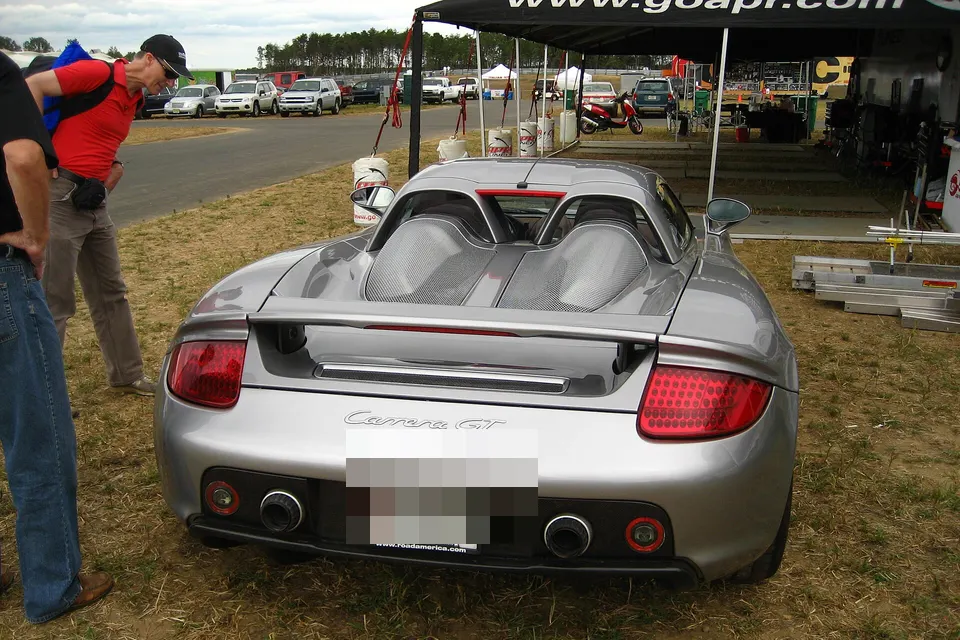
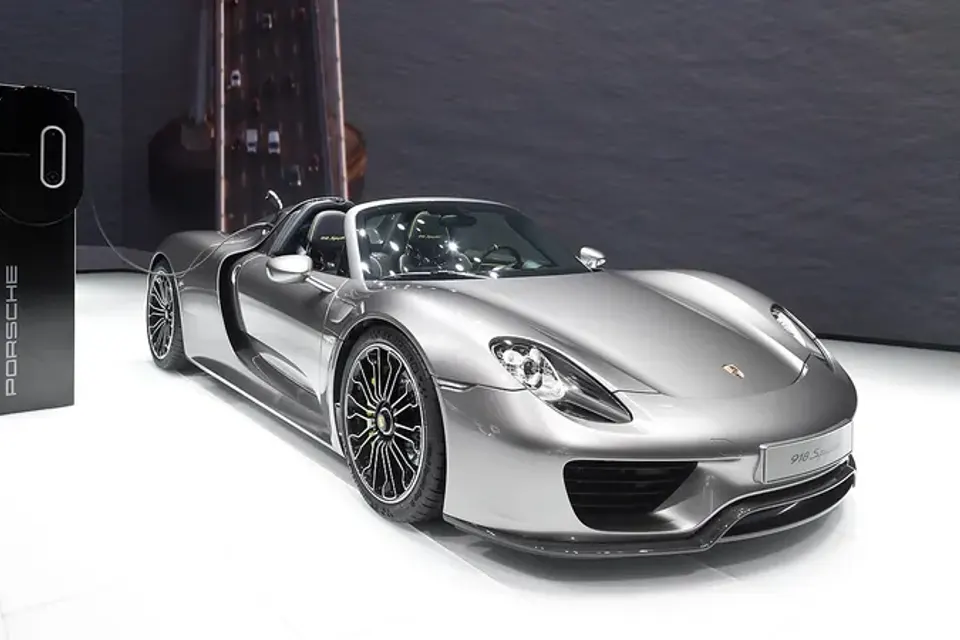
Historically, the 959 sits before the Carrera GT and 918 Spyder in Porsche’s halo-car sequence, but its influence spreads beyond that line. Variable all-wheel-drive control informed the Carrera 4, tyre-pressure monitoring anticipated later safety systems and its sequential boost concept demonstrated how electronics could make extreme performance more usable. Its Dakar relationship also differs from the circuit ancestry of the Carrera GT. Calling both “supercars” is convenient, yet the engineering questions they were built to answer were fundamentally different.
Legacy and identity
The focus here is the regular Type 959 series car from 1986–1988 with the 450 PS M64/60 and variable all-wheel drive. It excludes the 959 S, Paris–Dakar competition cars, prototypes and later modified examples unless their changes are explicitly recorded. The car is a vivid snapshot of a future arriving early. Its exact cooling, sequential-turbo, transmission and production boundaries prevent the mythology of a technological landmark from swallowing the specification Porsche actually delivered.
01
Model identity
Type 959 is displayed prominently so this record cannot be confused with an adjacent derivative.
02
Original soundtrack
Modified exhausts, aftermarket induction and replacement EV sound packs are excluded.