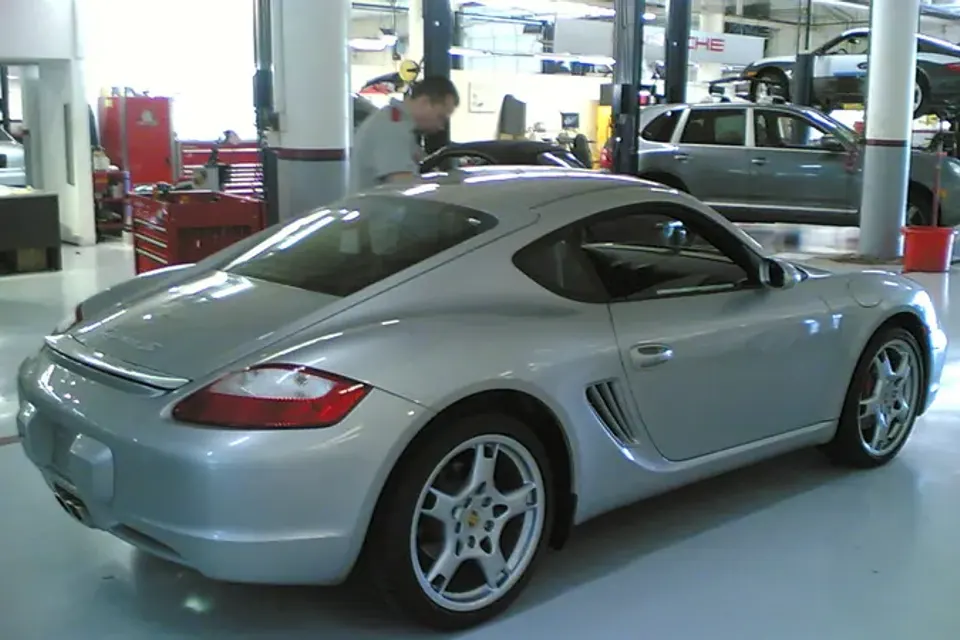
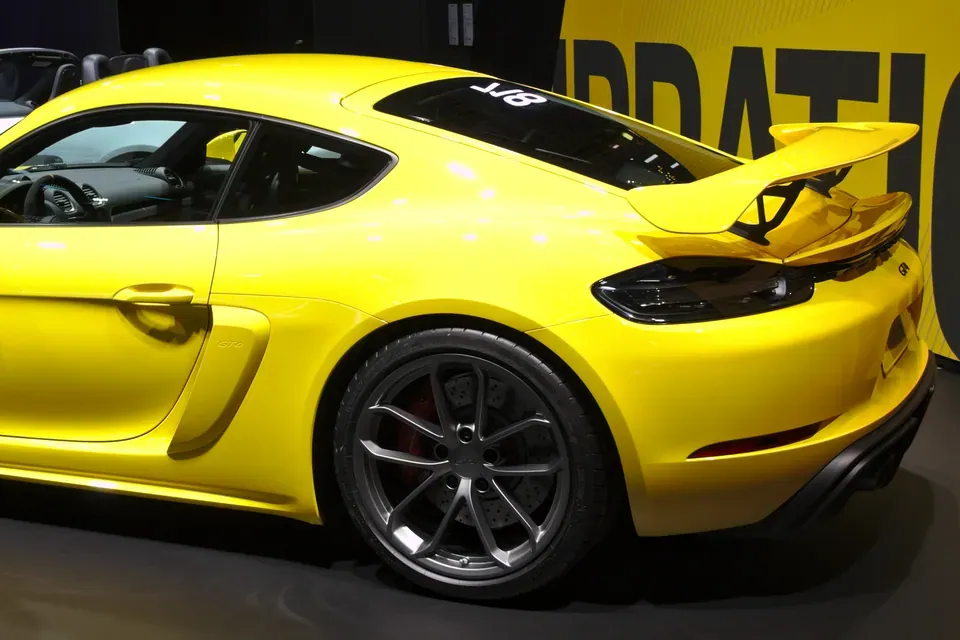
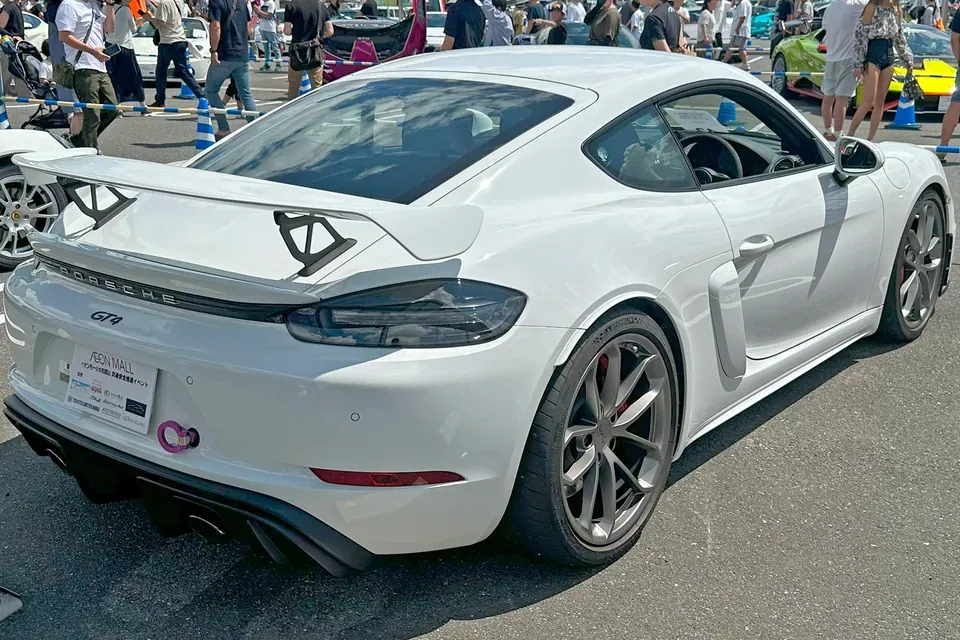
Documentary photographPhoto: Calreyn88 · CC BY-SA 4.0 · resized and cropped · Registration identifier pixelated for privacy.
Engine redprint / verifiedMA1.21
3.4 L flat-six · naturally aspirated · MA1.21Longitudinal mid-engine, rear-wheel driveTopology diagram · not to scale · based on the cited primary sources
A lighter, lower and more powerful Cayman whose focused road-car brief anticipated the first GT4.
R / production rarity
How rare is it?
A simple 1–5 rating based on completed worldwide production for this exact version. Price and desirability are not included.
Rarity ratingNot availableNo comparable worldwide production total
Production bandNot available
Production evidenceNo exact production total
ProducedWorldwide total used for the rating
Production total unavailable
A reliable worldwide figure is not listed in the references.
How the rating works
The rating uses five fixed production bands. Smaller production runs receive higher ratings. Exact totals and responsibly sourced estimates for this precise version can be rated. Plans, regional totals, lower bounds, disputed figures and broader-family totals remain visible but unclassified. The evidence description is kept separate from the rating so a source limitation cannot change how scarcity is measured.
Porsche introduced the Cayman R in late 2010 as the most focused road-going development of the 987 generation. It was not yet a formal GT-department model, but its priorities anticipated the Cayman GT4: reduce mass, lower the chassis, increase naturally aspirated output and make driver involvement more visible. The R suffix linked the car philosophically to Porsche’s lightweight tradition without turning it into a homologation special. Its importance lies in showing how much circuit credibility could be extracted from the existing Cayman S architecture.
The MA1.21 direct-injected flat-six displaced 3,436 cc and produced 243 kW (330 PS) with 370 Nm, ten PS more than the contemporary Cayman S. A six-speed manual was standard and a seven-speed PDK optional. The gearbox choice affects both mass and acceleration, while optional equipment can restore weight removed elsewhere.
Porsche lowered the sports chassis by 20 mm and saved 55 kg relative to a comparably equipped Cayman S through a coordinated set of measures. Aluminium doors, lightweight bucket seats, reduced equipment and 19-inch wheels all contributed to the intended response. Fixed rear aero and characteristic side graphics made the R recognisable, but neither creates identity on its own. Retrofitting decals or a spoiler to a Cayman S cannot reproduce the factory shell equipment, engine output, chassis calibration or documented model code.
Engineering and character
The mid-engine arrangement remained the foundation. Locating the flat-six immediately behind the seats keeps polar moment low and makes small changes in springs, alignment, tyres and unsprung mass readily apparent. The R’s achievement was to sharpen that existing balance without adopting the 911 GT3-derived chassis hardware later used by the 981 GT4. It should therefore be understood as a GT precursor rather than retrospectively relabelled as a GT4 whose badge had not yet been invented.
Its sound differs from the earlier 987.1 S because the MA1 engine uses direct injection and a different induction and exhaust context. The short distance to the cabin still makes intake prominent, while a manual exposes longer engine-speed transitions and a PDK introduces fast blips and upshifts. Sports exhaust may be factory option or later addition, so its presence and operating mode require evidence. A credible recording also states whether lightweight interior changes have altered cabin resonance from standard.
The Cayman R sits after the original 295 PS Cayman S and before the 981-generation GT4. The first GT4 would add a 3.8-litre Carrera S-derived engine, a mandatory manual gearbox and extensive 911 GT3 chassis components. That later car was a step into Porsche’s formal GT family, while the R remained a particularly disciplined series-derived road car. Preserving the distinction gives the R its own role instead of valuing it only as an imperfect preview of what followed.
Legacy and identity
The focus here is the 2010–2012 Type 987C.2 Cayman R with MA1.21 engine. It excludes ordinary Cayman S models, aftermarket R conversions, 981 cars and the competition-oriented GT4 line. Manual and PDK variants share the model but not every figure or sonic event, so transmission is mandatory capture metadata. The R is a clear lesson in the effect of mass and calibration; for specialists, the equipment-sensitive 55 kg claim and exact engine identity keep that lesson honest.
01
Engineering context
Direct-injected 3.4-litre flat-six with integrated dry-sump lubrication in a mid-engine installation.