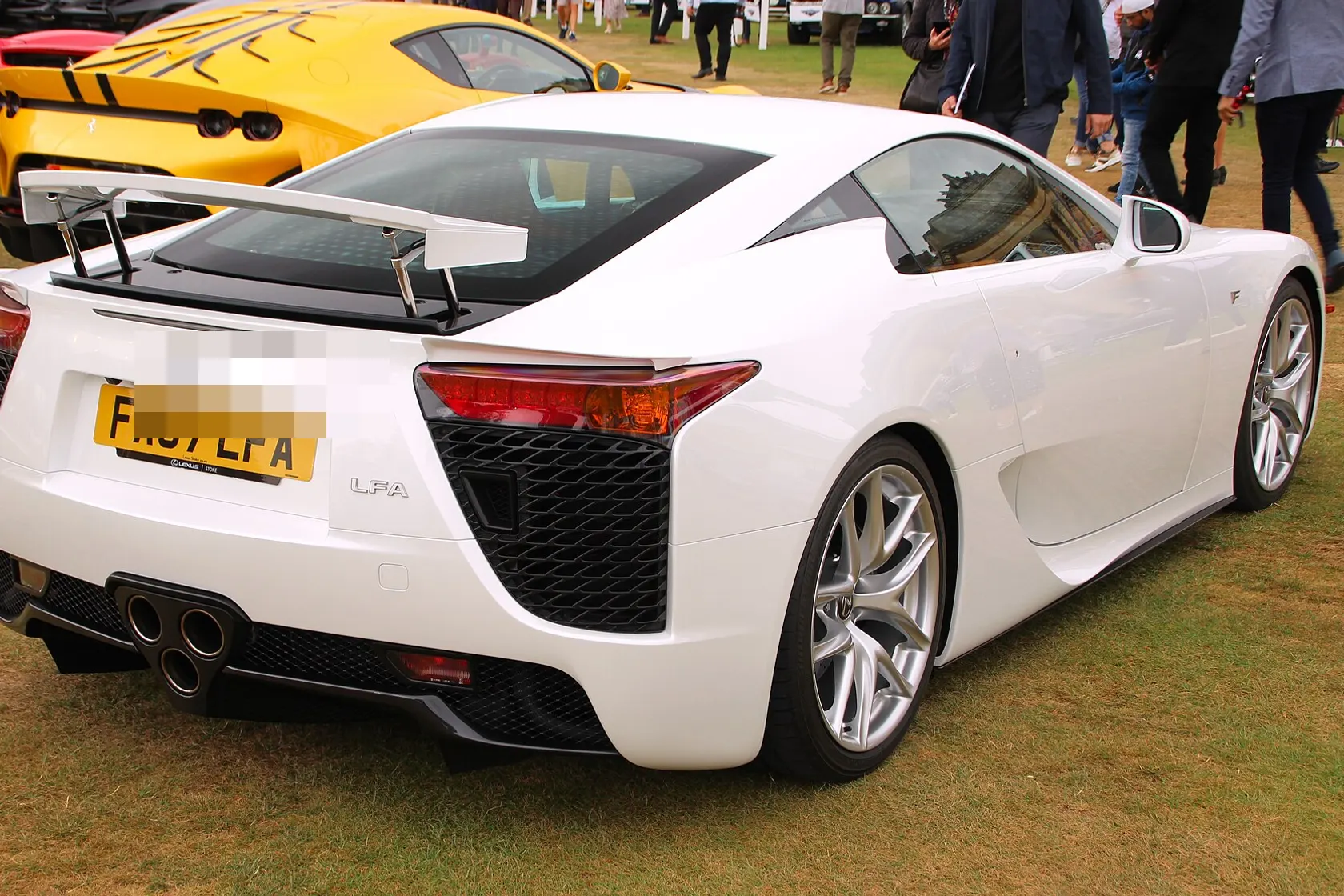
Documentary photographPhoto: MrWalkr · CC BY-SA 4.0 · resized and cropped · Registration identifier pixelated for privacy.
Engine redprint / verified1LR-GUE
72° V10 · dry sump · ten individual throttlesFront-mid engine, rear transaxle, rear-wheel driveTopology diagram · not to scale · based on the cited primary sources
Lexus’s 500-car halo coupé pairs a 9,000-rpm 4.8-litre V10 with a rear automated transaxle and deliberately tuned intake and exhaust paths.
R / production rarity
How rare is it?
A simple 1–5 rating based on completed worldwide production for this exact version. Price and desirability are not included.
Rarity rating3/ 5
Rare
Production band250 to 2,499 built
Production evidencePrimary-source exact
ProducedWorldwide total used for the rating500
Completed production
Figure type
Exact
Scope
Entire LFA series, including Nürburgring Package cars
The rating uses five fixed production bands. Smaller production runs receive higher ratings. Exact totals and responsibly sourced estimates for this precise version can be rated. Plans, regional totals, lower bounds, disputed figures and broader-family totals remain visible but unclassified. The evidence description is kept separate from the rating so a source limitation cannot change how scarcity is measured.
Equal-length manifolds and dual exhaust; titanium multistage muffler[2]
03 / context
History and character
Origins and context
Lexus announced the production LFA at the 2009 Tokyo Motor Show after a development programme that began around 2000. The project changed substantially along the way: an early aluminium structure gave way to carbon-fibre-reinforced plastic, while Nürburgring 24-hour entries in 2008 and 2009 provided a demanding development environment. Production ran at Motomachi from December 2010 to December 2012, limited to 500 cars and assembled at no more than 20 per month, with each engine carrying its builder’s signature.
The 1LR-GUE is a 4,805 cc, 72-degree naturally aspirated V10 developed with Yamaha expertise. It produces 412 kW (560 PS) at 8,700 rpm and 480 Nm at 6,800 rpm, with a 9,000 rpm limit. Ten individual electronic throttles, dry-sump lubrication, lightweight internals and a 12.0:1 compression ratio allowed the engine to be physically comparable to a V8 and light enough to support front-mid placement. Ninety percent of peak torque was available from 3,700 rpm in Lexus’s launch data.
A purpose-built six-speed Automated Sequential Gearbox sits in a rear transaxle, helping target a 48:52 front-to-rear weight distribution. It is a single-clutch automated manual, not a torque-converter automatic or dual-clutch gearbox. Paddle-selected upshifts could take 0.2 seconds in the fastest setting, while Auto, Sport, Normal and Wet modes changed control strategy. The shift interruption is a genuine part of the LFA’s cadence and should not be judged or recorded as though it were a seamless modern DCT.
Engineering and character
Carbon-fibre-reinforced plastic makes up 65 percent of the body-in-white, with aluminium accounting for the balance; Lexus stated that the approach saved about 100 kg against an equivalent aluminium body. Carbon-ceramic brakes, a wishbone front and multilink rear suspension and active rear aerodynamics supported 325 km/h and 0–100 km/h in 3.7 seconds. Individual equipment can move kerb weight across a range, so the lightest 1,480 kg figure is not automatically universal.
Lexus called the acoustic programme “Octave Harmony.” The surge tank, ten throttles, equal-length exhaust manifolds and titanium multi-stage rear silencer were tuned together to create different harmonic bands as engine speed rose. The digital tachometer was chosen because the engine could change speed too quickly for a conventional needle to display accurately. A premium recording separates intake, cabin and tailpipe perspectives and identifies ASG mode, exhaust originality, temperature and microphone response rather than chasing only the loudest high-rev clip.
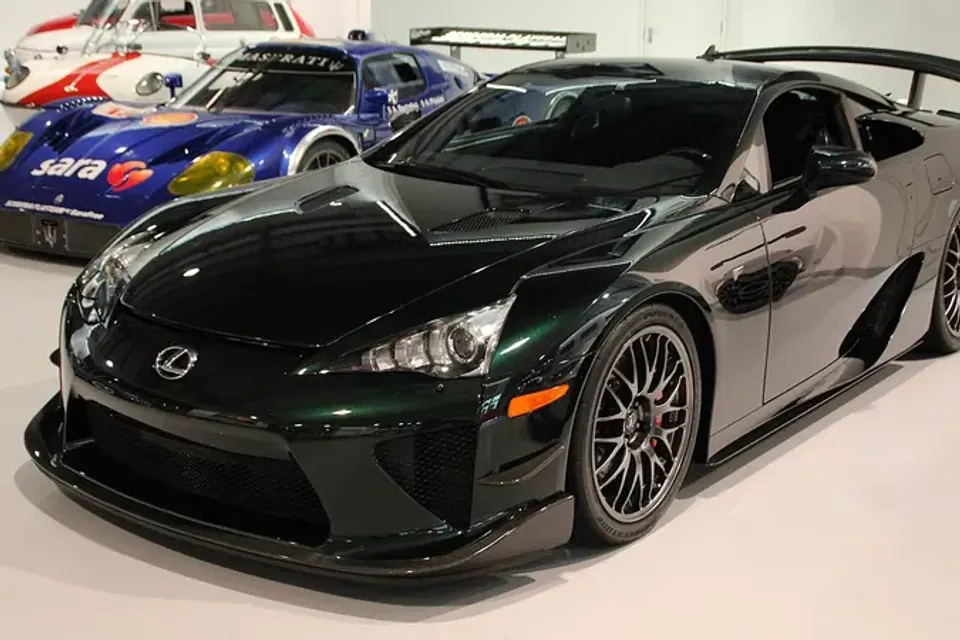
The Nürburgring Package is a separate derivative within the 500-car run. It adds output, shorter shift logic, fixed aerodynamics, altered suspension and specific wheels and tyres. Those changes mean its 571 PS and circuit claims cannot be applied to the standard LFA. Likewise, the 2005 and 2007 LF-A concepts are developmental ancestors, not production specifications. The base LFA deserves its own record as the complete road car around which the rarer package was defined.
Legacy and identity
The focus here is the 2010–2012 production Lexus LFA LFA10 with 560 PS and the six-speed ASG rear transaxle. It excludes prototypes, race cars, Nürburgring Package examples and modified exhaust systems. For a general reader, it explains why Lexus spent a decade creating a 500-car V10 halo model. For a purist, the exact induction, transaxle, carbon construction and acoustic architecture show that the celebrated sound was not an accident—it was engineered across the entire airflow path.
01
Digital tachometer
Lexus used an electronic display because the engine could change speed too quickly for a conventional analogue needle.
02
48:52 distribution
The front engine and rear transaxle were arranged to target a 48:52 front-to-rear weight balance.
03
Sound by architecture
The soundtrack comes from tuned intake and exhaust hardware, not a later overlay added to disguise the powertrain.