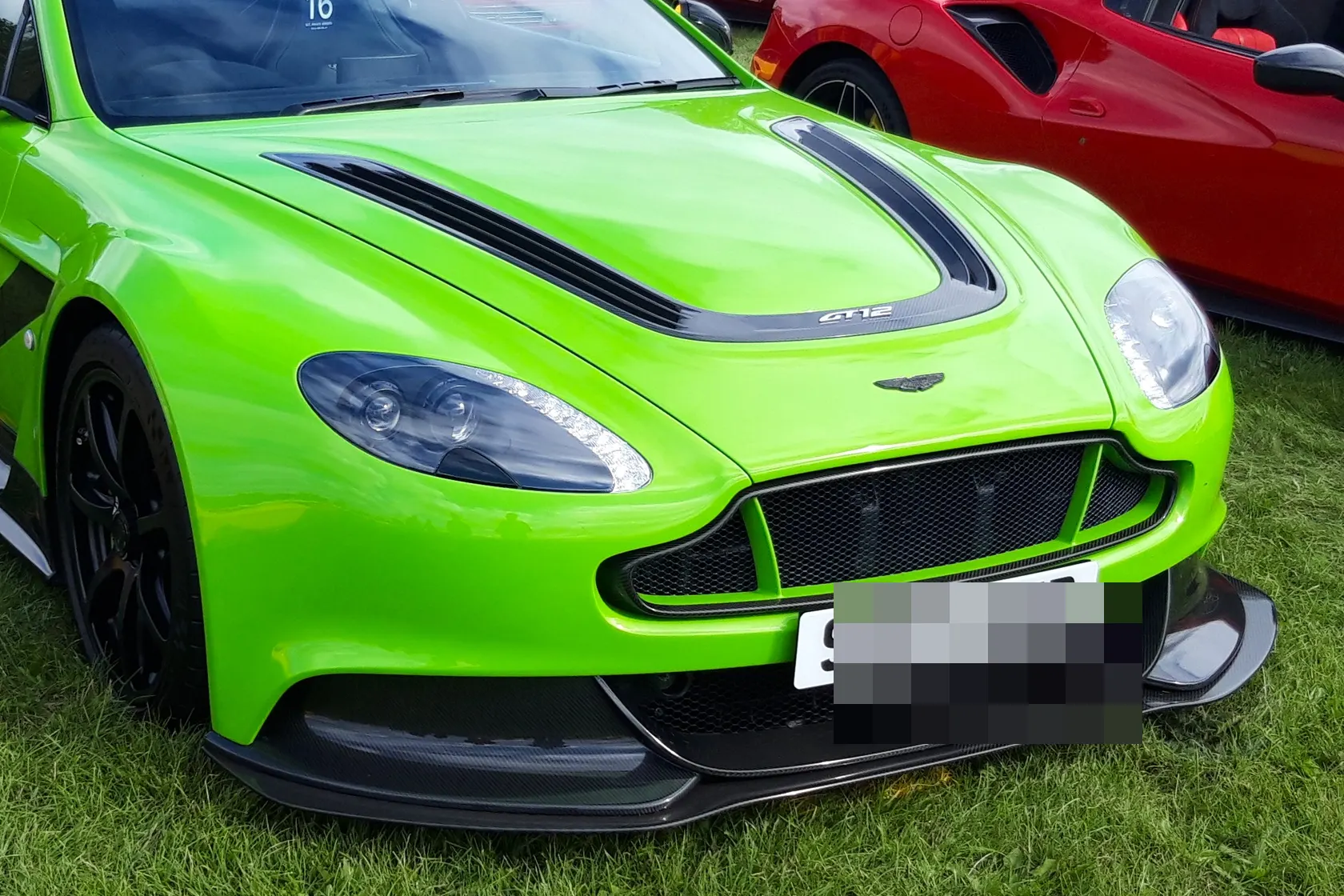
Documentary photographPhoto: MrWalkr · CC BY-SA 4.0 · resized and cropped · Registration identifiers, visible labels and identifiable bystanders pixelated for privacy.
Engine redprint / verifiedAM28 5.9 L V12 GT12
5.9 L v12 · naturally aspirated · AM28 5.9 L V12 GT12Longitudinal front engine, rear transaxleTopology diagram · not to scale · based on the cited primary sources
The GT12 translated Aston Martin’s GT racing theme into a highly differentiated, limited-production V12 road car with major aerodynamic, chassis and mass changes.
R / production rarity
How rare is it?
A simple 1–5 rating based on completed worldwide production for this exact version. Price and desirability are not included.
Rarity rating4/ 5
Very rare
Production band25 to 249 built
Production evidencePrimary-source exact
ProducedWorldwide total used for the rating100
Completed production series
Figure type
Exact
Scope
Vantage GT12 road cars, excluding competition GT3 cars and later commissions
The rating uses five fixed production bands. Smaller production runs receive higher ratings. Exact totals and responsibly sourced estimates for this precise version can be rated. Plans, regional totals, lower bounds, disputed figures and broader-family totals remain visible but unclassified. The evidence description is kept separate from the rating so a source limitation cannot change how scarcity is measured.
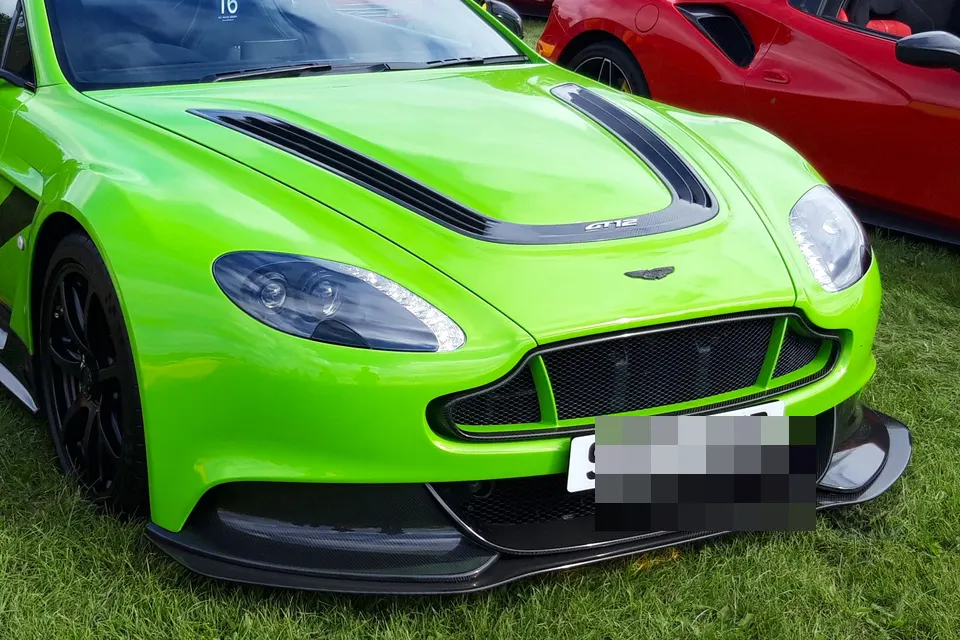
The Vantage GT12 began public life under a GT3 name, but Aston Martin changed the production designation before customers received cars. The final GT12 was a road-going special shaped by the company’s competition programme rather than a homologated race car. Its wide body, aerodynamic devices, reduced mass and chassis tuning move it well beyond a V12 Vantage S appearance package.
Its 5,935 cc naturally aspirated V12 produced 600 PS and 625 Nm, sent through the seven-speed Sportshift III automated manual transaxle. The higher-output engine, titanium exhaust and lighter cabin give recordings a sharper path from combustion to microphone than in the more insulated Vantage S. Gear changes remain automated-manual events, with clutch disengagement and renewed load audible rather than the continuous delivery associated with a torque-converter transmission.
Aston Martin’s corporate production record identifies 100 cars made from roughly October 2015 through May 2016. That documented boundary supports a completed 100-car production statement. It does not include competition GT3 machinery, prototypes or later one-off commissions. The car’s launch-era GT3 label should appear only as historical context, because applying it as the canonical production name would invite confusion with the actual racing model.
Engineering and character
The chassis is equally important to identity. Carbon-fibre exterior panels, a wider track, substantial aerodynamic additions, revised suspension and optional lightweight equipment served a focused road-car brief. Exact mass varies with equipment, so the archive does not present one lightweight claim as universal. A source image establishes an outwardly exact GT12, while its service record must establish that exhaust, intake, suspension and calibration remain representative.
For RevAtlas, the GT12 is an unusually clear bridge between Aston Martin road and racing language. It can be compared with the V12 Vantage S to hear how exhaust construction, insulation, calibration and gearshift strategy alter the same basic engine family. Useful submissions need driving mode, exhaust-valve state, gearbox setting and modification evidence, especially because these cars are often used at events where nearby vehicles can contaminate a recording.
The pre-production GT3 name, V12 Vantage S, competition GT3 cars and later special commissions are excluded. Similar badges can cover different engines, transmissions, bodies and production programmes. Preserving those distinctions prevents a familiar name from becoming a blended specification that no single production car carried.
Legacy and identity
The mechanical reference is the AM28 5.9 L V12 GT12, a 5,935 cc naturally aspirated v12 represented at 441 kW, 600 PS and 625 Nm. It works through a 7-speed sportshift iii automated manual with rear-wheel drive. Units and period rating conventions stay visible rather than being treated as directly interchangeable.
For sound documentation, the principal markers are 600 PS naturally aspirated V12, titanium exhaust, Sportshift III changes, reduced-insulation cabin detail. A cold start must include uninterrupted cranking, first combustion and settling idle. Acceleration and fly-by submissions need gear, load, safe road or closed-course context, microphone position and weather. Factory-stock status requires evidence for intake, forced induction, catalysts, gearbox and silencers.
A photograph can establish useful visual context but cannot prove mechanical originality. Restoration, service replacement and reversible modification are common across performance cars. RevAtlas records configuration component by component, allowing modified survivors to remain useful without presenting them as untouched references. That method gives the Vantage GT12 a defensible page now and an exact home for future evidence.
01
Model identity
The focus here is the 100-car road-going Vantage GT12 programme. The pre-production GT3 name, V12 Vantage S, competition GT3 cars and later special commissions are excluded.
02
Why it matters
The GT12 translated Aston Martin’s GT racing theme into a highly differentiated, limited-production V12 road car with major aerodynamic, chassis and mass changes.
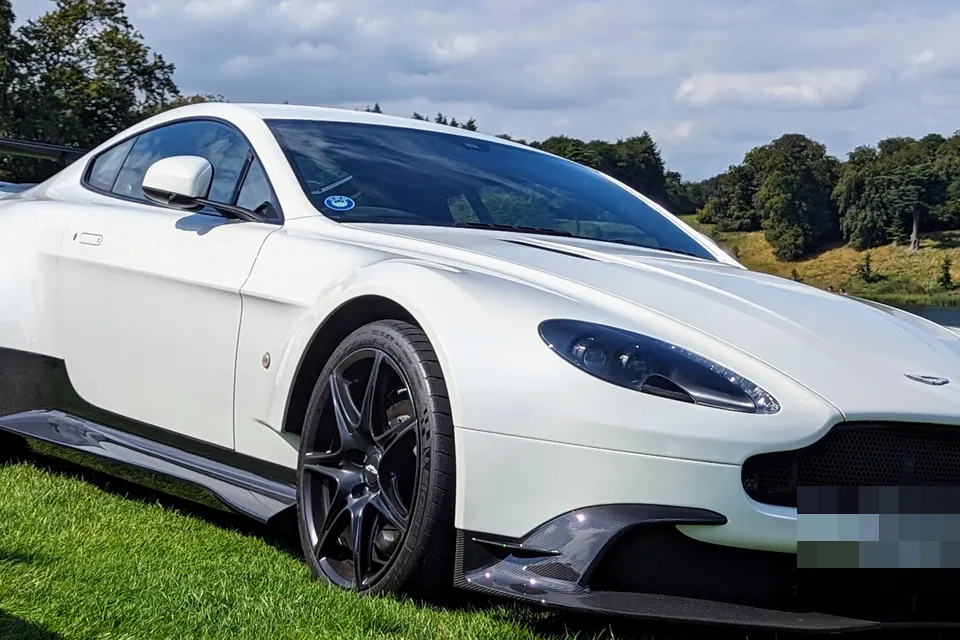
2013V12 Vantage S (VH1 V12 Vantage S)View passport ↗The V12 Vantage S was the faster, more powerful development of Aston Martin’s compact VH sports car, and its later dog-leg manual preserved a rare twelve-cylinder analogue configuration.[1][2]
→
Photo: MrWalkr · CC BY-SA 4.0 · resized and cropped · Registration identifiers, visible labels and identifiable bystanders pixelated for privacy.
2015Vantage GT12 (VH1 GT12)Current model: The GT12 translated Aston Martin’s GT racing theme into a highly differentiated, limited-production V12 road car with major aerodynamic, chassis and mass changes.[3][5]
→
Photo: Calreyn88 · CC BY 4.0 · resized and cropped · Registration identifiers, visible labels and identifiable bystanders pixelated for privacy.
2016Vantage GT8 (VH1 GT8)View passport ↗The Vantage GT8 was the lightest and most circuit-influenced V8 derivative of the original VH Vantage, with substantial body, chassis and mass differentiation.[7][8]
06 / contribute sound
Help us hear this car
Share a properly licensed recording of this exact model. Stock and modified cars are both welcome when their configuration is described clearly.